
I stepped back into Teyvat in 2026 just as the bubble crisis arc reached its official close.
The tension that had been simmering across the expeditionary force finally gave way to something quieter, more communal.
In typical HoYoverse fashion, the update pivots from high-stakes danger to celebration.
I immediately noticed how the narrative uses the homecoming not just as pageantry, but as a reflective pause.
For long-time players, this is a familiar rhythm: tension erupts, a crisis is averted, and the world returns to a new normal.
The difference is that the new normal never feels quite the same as before.
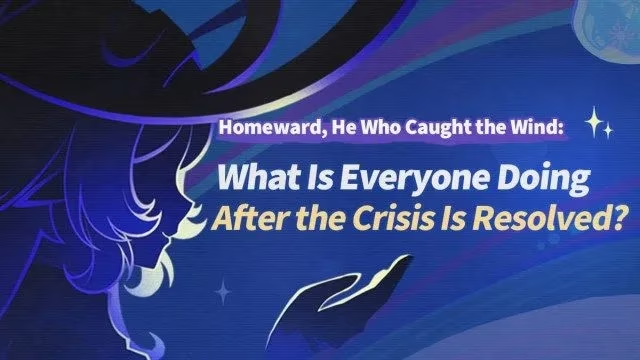
A Ceremony With Real Narrative Weight
Once the threat inside the bubbles was neutralized, the game invited players to a homecoming ceremony.
I expected a simple celebration, but the event quickly became more than that.
The gathering touches on trust, alliance, and the bonds forged under duress.
It asks players to witness what everyone is up to after the crisis.
That prompt is important.
It is not a throwaway line; it is a clear signal to check in with both major and minor cast members as they process recent upheaval.
The official framing emphasizes the return of peace and progress.
While the event celebrates a successful homecoming, it also functions as a statement of world state.
Genshin Impact has long used ceremonial closures for lore exposition and emotional pacing.
The bubble crisis was not the largest lore shakeup, but it positioned several characters in rare alignment.
The homecoming codifies that unity.
What the Official Materials Tell Us
The patch number is not stated in the official materials, which leaves some mechanical details open.
Still, the update provides enough structure to understand its intent.
-
Crisis Resolution: The bubble threat has ended and security has been restored.
-
Homecoming Ceremony: The event serves as an official welcome for the expeditionary force's return.
-
Character Spotlights: Key cast members appear in new post-crisis contexts.
-
Social Media Engagement: Official Genshin Impact accounts host discussions, recaps, and art.
-
Event Rewards: Not specified in official materials.
I found it useful to treat the event less as a reward farm and more as a narrative checkpoint.
The lack of reward details is notable, but I still logged in daily.
Genshin has a history of locking important story scenes behind limited windows.
Familiar Mechanics, Familiar Parallels
The event reuses social interaction and quest-completion models from earlier festivals.
This is not a criticism.
Those systems are familiar because they work.
They let the world breathe after a major conflict.
| Event/Parallel | Shared Feature | Narrative Function |
|---|---|---|
| Lantern Rite | Social interaction and gathering mechanics | Community healing and recognition of heroism |
| Windblume | Festival rhythm and dialogue check-ins | Post-conflict public ritual |
| Bubble homecoming | Ceremony, dialogue, and reunion moments | Unity, hierarchy shifts, and foreshadowing |
These post-conflict gatherings echo Lantern Rite and Windblume.
In each case, the aftermath of danger catalyzes public rituals.
Timelines suggest that each new region or major patch now concludes with increasingly elaborate restorative sequences.
That trend tightens the playable world's sense of continuity.
It also supports the live-service model's rolling reset.
Character Dynamics and Foreshadowing
Official materials do not specify individual character arcs, but early player reactions are already focused on several details.
I watched the dialogue close-ups carefully.
The subtle emotional shifts are there if you look.
- Shifts in command hierarchy: The expeditionary force may have new leaders after the crisis.
This could affect future questlines.
-
Tenuous alliances: Characters formerly at odds are expressing new forms of camaraderie or mutual respect.
-
Foreshadowing: Environmental cues and dialogue hint at unresolved tensions and lingering mysteries.
The ceremony is not an epilogue.
It is a prologue.
New mysteries, shifting loyalties, and evolving events are just beyond the horizon.
If the hierarchy post-crisis holds, players may see new quest leaders or event hosts in coming updates.
Why This Matters for the Road Ahead
I have learned to read Genshin's ceremonies as structural signals.
The escalation in ceremonial detail may foreshadow similar end-state events for upcoming regions such as Fontaine and Natlan.
Genshin reinforces its worldbuilding through shared cultural acts.
That makes each celebration feel personal, but also deeply connected to the larger map.
The event's regional linkage matters.
A celebration is rarely just a celebration in Teyvat.
It can signal shifts in power.
It can introduce emerging antagonists.
It can quietly reposition which characters will lead the next story beat.
How I Approach the Event Window
If you want to optimize participation, log in during the event window.
Key story moments in Genshin are often available only for a short time.
I also monitor official social channels for behind-the-scenes art, Q&As, and epilogue participation content.
-
Revisit character scenes before they cycle out to catch limited-time lore drops and unique voice lines.
-
Check official accounts for recaps and event art.
-
Keep an eye on future banner cycles, though exact banners or phases are not stated in official materials for this event.
In the end, Genshin Impact's post-bubble ceremony is a careful piece of design.
It ties together crisis response, community celebration, and the subtle reshaping of relationships.
I left the event feeling like something had ended, but also like something else had quietly begun.
In 2026, that is exactly the kind of narrative knot that keeps me coming back to Teyvat.
Comments